Thursday, 11 February 2021

Bursts and bubbles 2020 in reflection.

 We are heading into a new era with a new build and new staffing structure. The school identified focus areas that they were keen on developing further.

We wanted to understand how collaboration can support and better our classroom practice. However early on with this inquiry we realised that we needed to deepen our knowledge of what collaboration is and how it looks in different settings. . 

To build a rich picture of our staff's  understanding we completed a survey with our colleagues and noticed that they too had varying ideas of collaboration. This became our starting point. 

The main patterns we  identified were barriers such as time, relationships our schools site locations and the unknown of working with another. .

When researching collaboration we were lead to other key vocabulary such as Collegiality, cooperation and co teaching styles. These were explained to us as a scale of intensity of how people communicate and work together. 

Collegiality:  respect to colleagues and interests in each others well being. 

Cooperation - This is when a person supports someone else in their work or goal.

Collaboration-   When we work together to achieve a common goal

We had a peer observations over the year that showed our strengths lie in effective use of space, worked well with TAs who had a strong understanding of the lesson and confidence to lead small groups. This was a key area of learning for us as we could then recognise the difference in terminology. As teacher’s we collaborate together for planning and activities and creating the children's learning goals. However with our teacher aids we cooperate as they support the children to achieve the goals and learning outcomes we have set. These are both crucial for positive learner outcomes. Our teacher aides are a significant resource in a our school and we need to ensure that their time and knowledge is used well.

Originally the co teaching models by Friend, Reisling and Cook (1993) were based off mainstream teacher + special ed teacher. We have analysed this model and noted that we have different student/staff ratio so we are able to be more creative and divide our learning into slightly different groups. We found a common style used was station teaching but when looking deeper, what does this mean to different people, who is static and who is moving? When observing Stonefields school we could see this in action with the use of an independent station encouraging peer collaboration. This made us reflect how can collaboration impact our learners and how can we encourage collaboration among learners?


The changes we made related specifically to time given to discussing with TAs the outcomes for the week and explaining individual's needs as well as beginning to incorporate activities that introduce the concept of collaboration between learners. To develop the skills on how to follow instructions and listen to our peers we have started using LEGO therapy as it fosters collaboration giving specific roles while  working together to complete the same LEGO kit. For our older learners we have started using google slides so the children can learn to collaborate through technology. They loves seeing each other icons on the screen. Through ENGAGE they are learning to tolerate others in their space, increase resilience and encourage positive waiting and turn taking. These are vital skills for our tamariki to develop, to benefit from collaborative teaching but also to increase their engagement in collaborative activities. 


Where to next: Linking with the schools new strategic goals,  we feel the need to create a common language amongst our school relating to collaboration and share ways of co teaching successfully. We want to open their eyes to the possibilities  that working collaboratively creates. Keeping in mind that a prime reason for creating a culture of collaborative practice is, to impact positively on student outcomes (DuFour and Mattos (2013).


Sunday, 13 September 2020

Challenges in collaboration

 Expand on my knowledge of multidisciplinary team approaches by identifying key challenges in collaboration using a range of perspectives from my community of learning (COL).


Recently Sharon and I discussed the challenges of collaboration. Last year one of us was on leave for a term after an accident and this year the other had extended leave for family reasons. This made us think about how a team approach is affected when part of the team is not there, with limited time to prepare for their absence. This made us realise the need to reflect on other challenges within the day, week or programme that are a reflection of a group of people working together in collaboration of multidisciplinary approaches. 

I created a Jam board with my COL group to share 5 key ingredients to successful collaboration and then also for everyone to name a key challenge. In our school setting we also work as a multidisciplinary team with Occupational therapists, Speech and Language Therapists and Physiotherapists. I also made a Jamboard with the specialists we work with and completed the same exercise. There was a common theme among the message of challenges. 


For collaboration in the classroom to be successful there needs to be synergy, trust, communication and shared accountability. There is also a reliance on each other for support in planning, teaching, managing the classroom and family contact. When one part of the team is absent it can dramatically affect the flow and stress of the other. Even if there is someone covering that is familiar and knows the running of the class the remaining teacher still feels more responsible for the extended group and is required in more places at once that they would be otherwise.Successful collaboration should see increased independence in student learning and the staff members should be extensions of each other giving children the opportunity to learn in different settings maximising the space and adult ratio. When a staff member is away for extended periods of time the expectations of this may need to be altered to suit the new teacher and to suit how they work with the planning and the learners. There is extra time required for the teacher remaining to contact and be available for whānau communication of all learners. As like any new partnership in cooperative teaching there can also be differences in expectations when new members arrive and this can lead to a change in programme design. 

Working collaboratively with other teachers requires time to be reflective as a team. Benade, G.,(2017) states that collaboration “requires participants to meet regularly and to take the time to develop professional collective responsibility”. Time came up as a challenge across both Jam boards and through literature. A research article studying SCERTS as a multidisciplinary framework reported 50% of the people in the study found that collaboration takes time and demands a lot of energy (Paola Molteni, Karen Guldberg and Nick Logan, 2013). Time is needed to reflect on the issues involved in the teaching and learning and also time to discuss how the collaboration design is being implemented and how it worked in each session. Our specialist Jam board suggested that time is a challenge in both arranging times to meet with teachers and students and also time within the week for the programme they supply to be implemented. For implementation to be successful they reported that trust and rapport needs to be established and developed and this also is affected with lack of time. When there is trust and support, collaboration is more successful as the team begins to understand how each other works and can begin to compromise and acknowledge each other's ideas and valuing everyone's opinion. 

It is important to discuss the challenges of collaboration as it becomes more common practice among Modern Learning Environments. “Being aware of the possible difficulties of implementing multidisciplinary teamwork can strengthen not only the team of professionals,  but the management department, as it can support the planning of meetings and quality evaluations following the real educational needs of the child and of the team.” (Paola Molteni, Karen Guldberg and Nick Logan, 2013). Multidisciplinary interventions and support in my school setting in particular is vital for it allows for a wider focus with different expertise available. Working together we can address a range of teaching techniques, targeting different skills across different contexts. This is fundamental to creating an effective educational approach”(Paola Molteni, Karen Guldberg and Nick Logan, 2013).

Reference List:

Achinstein, B (2002). Conflict Amid Community: The Micropolitics of Teacher Collaboration. Teacher College Record Volume 104 Number 3.

Benade, G (2017) What is professional collaboration and how can its practice be enriched and led to support student learning within and across schools? Sabbatical Report. Sancta Maria Catholic Primary School, Flat Bush, Auckland.

Bradbeer. C, Martin S, (2016), Creating Collaborative Effectiveness One Schools Approach. Teachers as Communities of Learning Professionals, Set 2. 

Education Council New Zealand–Matatū Aotearoa. (2017). Our code our standards: Code of professional responsibility and standards for the teaching profession: Ngā tikanga matatika ngā paerewa: Ngā tikanga matatika mō te haepapa ngaiotanga me ngā paerewa mō te umanga whakaakoranga

Molteni. P, Guldberg. K and Logan.N (2013) Autism and multidisciplinary teamwork through

the SCERTS Model. British Journal of Special Education. NASEN DOI: 10.1111/1467-8578.12030


Monday, 17 August 2020

Collaborative observation at Stonefields school


What did we see?

Today, we were lucky enough to observe a variety of teams collaborating in Stonefields school. Hub 9 who have Year 7/8 learners, Hub 7 who have Year 3/4 learners and Hub Koru who are Year 0/1 learners.

It was a great experience for us, we saw a variety of collaboration being used within all the hubs.

After our PD with Chris Bradbeer, we were able to identify what forms of co teaching the teams use in the hub. This is just a snapshot of how the teams teach collaboratively during a specific learning time.

Hub 9: We saw alternative teaching  happening with a bigger group learning in a workshop and the other teachers roaming  and touching base with independent learners. The teachers then swapped places and one took a workshop whilst the other checked in with the high achieving group.


Hub 7: Alternative teaching was being used,  where a workshop was taking place with a smaller group of children. Another workshop was taking place for those learners who needed a little extra support. Some children were working collaboratively in small groups. They had a checklist created by the teachers to aid their learning. They are at the beginning stages of learning how to collaborate.  These groups were being supported by a roaming teacher.

                Student group work, collaboratively working with a checklist to guide their learning

Hub Koru: Initially the whole hub came together. This was to divide the children up and make sure they went to the correct teacher for their next learning as they are Year 0 and 1.
We then observed parallel teaching but differentiated to suit each groups needs. The groups were ability organised.
One children had about 10mins independent learning with a teacher as this best suits their needs. The rest of the group were working on independent activities.


This was a great opportunity for us to check our learning of the terminology Chris has taught us about co teaching. We could see how the type of collaboration was adapted across the year levels of the school. We could see commonality with how we structure our lessons mainly with Hub Koru, we can now see how using things such as checklists and workshops can be successful in our learning space to strengthen both ours and our students collaborative practice. 

Thursday, 30 July 2020

Collaboration PD

PD for the Sommerville COL teachers with Chris Bradbeer:

Last term we were lucky enough to be able to organise some PD with Chris Bedbeer, who has lived and breathed collaboration through the design of MLEs

He has shared with us his understanding of collaboration and the benefits and challenges it creates. Through his extensive research he has learnt to define collaboration as “A process through which parties who see different aspects of a problem can constructively explore their differences and search for solutions that go beyond their own limited vision of what is possible”(Gray, 1989, p. 5). This aligns with how TKI is also defining collaboration, “Collaboration is the process of working together to achieve a common goal. In teaching, the common goal is always improved learner outcomes.” (TKI).

To be able to use collaboration in the classroom effectively people must know the difference between collegiality, cooperative learning and collaboration. Chris explains that these can be looked at as a scale of intensity of how people communicate and work together. See graphic below:


Collegiality “Collegiality refers to opportunities for faculty members to feel that they belong to a mutually respected community of scholars who value each faculty member’s contributions to the institution and feel concern for their colleagues’ well-being.” (Gappa, Austin, & Trice, 2007, p. 305).

Cooperation - This is when a person supports someone else in their work or goal.

Collaboration-   When we work together to achieve a common goal.


Chris shared with us the co teaching strategies and how these look in the classroom. There are 6 different approaches. We discussed that these can be used interchangeably throughout the day or week to suit what is needed for student success. Please see table below for the approaches.


Key Benefits of collaboration:

  • Teach to your strengths
  • Support one another
  • Opportunities to learn from and with each other
  • Improved student outcomes 
  • Opportunity for social learning 

Key Challenges of collaboration:

  • Hierarchy challenges
  • Time and workload
  • Personality types

We will know that collaboration is successful and that working together is synthetic when learner engagement is positively impacted. This session with Chris reflects back to our hypothesis as it begins to inform our practice to see how we can be on the same page of what collaboration means and how it looks in the classroom. If student achievement and engagement is the destination think of teacher collaboration as the journey. Collaboration is dynamic and is an ongoing process, enhanced by different peoples ideas and strengths and accommodations.


Thursday, 23 July 2020

Inquiry into our collaborative practice - Reflection

Towards the end of term 2 Sharon and I started our inquiry into our own teaching practice looking at our hypothesis on what does effective collaboration look like? The strategies we have used for this was a peer observation where we had a colleague come and spend a morning observing the collaboration happening across the learning space and give us feedback and take pictures to show us objectively what the room looked like during learning time. We also looked at our planning time together. Sharon and I work in a modern learning environment with two classes, we do our long and short term planning together. During Term 2 holidays we started our planning for term 3 we took photos and used the strategy of stop-think-reflect to consider how we were collaborating and if we thought the planning session was successful.

Devs came to observe one of our lessons together which was fantastic as she is also looking at collaboration for her inquiry. During the time she was with us she gave us some great feedback on our strengths making comments about how we used the space effectively and worked well with our teacher aids who knew the programme well and could successfully take small groups with the lesson knowledge and confidence to work as the lead on small groups. She took the below photo as she could see that there were 3 teachers working in a close space with their own groups on different and appropriate activities. From our reading on co teaching we know this is station teaching. We also used alternative teaching where 1 staff member worked with a large group and other staff members worked with small groups. The lead teacher in this session was also a teacher aid who takes the class for music.

An area for development that Devs pointed out was how we use our voices when we are all running station groups. We need to be mindful of how loud we are and the pitch in our voices as it could cause distraction for others learning close by. We will also look at ensuring our teacher aids move around into different learning spaces so that they are not always teaching at the same station. This is something we are going to adapt in our planning and will have another observation later into the term to see if there is progress in these areas.

During the holidays Sharon and I had this photo taken of us working together on our long term planning. We were very mindful that session on how we collaborated and how we shared responsibility when it came to planning. We would start a session, stop, think and reflect on how we were working together. Sharon and I have started working our long term planning into more detail so that there is a weekly plan and learning intention for each session so our weekly planning is simplified and takes less time. When collaborating you need to find ways of working smarter as you have to fit into each other's schedule.

Through this planning session  our apparent strengths were: 

  • Brainstorm together to make links across the curriculum and key competencies 
  • Link to each others students so that we can benefit all learners
  • Set targets of what we want to achieve by a certain time to keep us motivated and on track
  • Delegate well, finding and making resources, each work on a different curriculum area and then share together.
  • Both enjoy working with other staff members to share ideas, planning and learn from others. 

Ares for development:

  • Both are very excitable and can distract each other with new ideas and end up going down resource rabbit holes. 
  • Are we overloading our timetable? Both of us are keen on extending our own knowledge and will often come to planning meetings with new concepts and interventions to try which may result in us removing other successful aspects of the timetable from previous terms.   
  • Have more opportunity for more student input and reflection so student voice is visible in our planning. 


We now have areas to improve our practice on effective collaboration. This will be our focus for term 3.

TA reflections and feedback: How has that impacted on our collaboration within our hub?

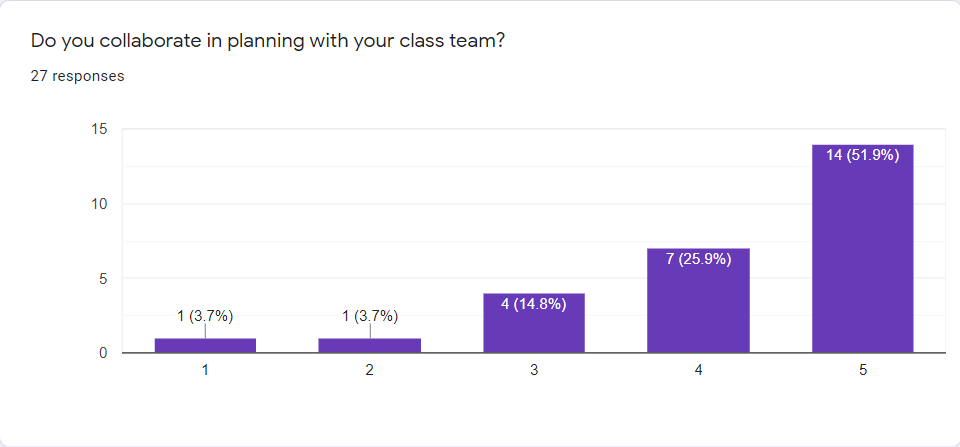
After surveying the teachers at school, we then surveyed the therapists and the teacher aides as these people are an integral part of our team. Each class has at least 2 teacher aides and a team of therapists, they are asked to collaborate and provide experiences that best suit and help individuals needs.

After receiving the feedback from 27 TAs and reading the responses Tash and myself reflected on the way we collaborate with our TAs. We know that we have a great team, the TAs are fantastic and we use some of their strengths. We think that we collaborate with them quite well…. But the survey made us reflect and question how can we make it better still. This relates back to our hypothesis:


Specifically:
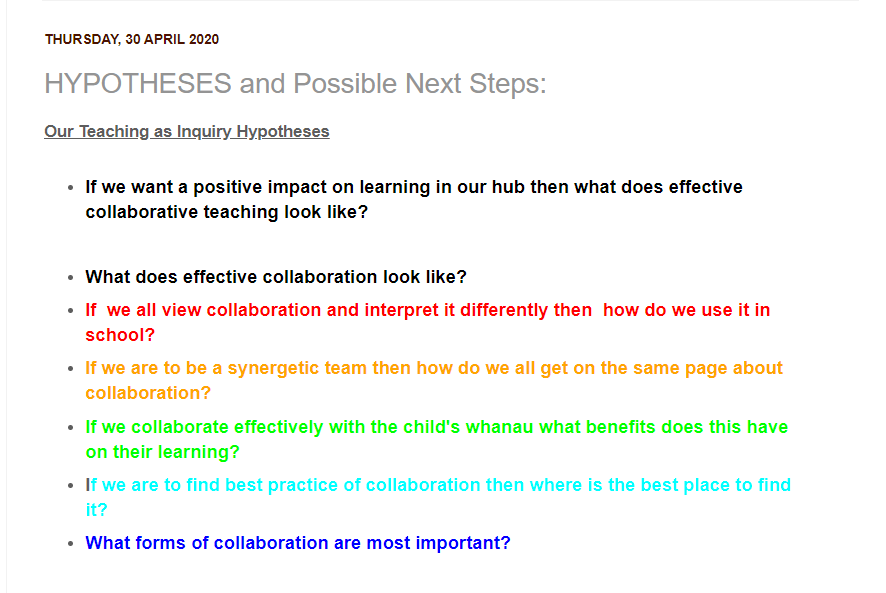
What does effective collaboration look like?
If we are to be a synergetic team then how do we all get on the same page about collaboration?

Previous to reflecting:
Our TAs co teach with each other when we learn through rotations, we have weekly meetings where we discuss how the week has gone and reflecting on the term. We have one TA who take our music as this is a strength of hers.We also have quick catch ups after learning during morning tea and lunch and at the end of the day to see how things have gone and ask specifically about individual learners and think about the next steps.

Is this enough….

When looking at the responses:

I feel that we could involve our TAs more with regards to the planning, especially by giving ourselves more time to reflect and talk about specific child’s needs.

I feel we do this quite well, we respect our TAs and encourage them to take the lead. We tend to set the activities, but again could they perhaps have more say in the type of activities set out.


Everyone who responded felt that collaboration is important. 


Hypothesis:
If we are to be a synergetic team then how do we all get on the same page about collaboration?

Next Steps: We love being a creative hub and feel that art and craft plays a significant role in children’s learning. We have a TA who has a passion for this area. With this in mind we have given her more control with regards to how and what learning in this area looks like. We discuss with her what outcomes we would like and share ideas about what we would like the children to experience, she in turn would share her knowledge and ideas. We have 1 TA who we can reflect with at the end of the day, but not the others as they leave the same time as the children, how can we get past this? In term 3 Tash and myself have worked out some time on Monday and Tuesday when we can touch base with our TAs to discuss the week ahead, the children’s IEPs and activities. We will also be able to use this time to record evidence around children’s IEP goals. As Tash is not in on Mondays we have also worked a time on Friday where she can go through learning for the following Monday. The teacher who covers for Tash plans with us about what happens on Mondays. We can use our weekly meetings with our TAs, more effectively. Term 3 will be a time for reflections on how we best collaborate with our TAs. During and at the end of the term, we will do a couple of posts to reflect on this, how it is going and get our TAs responses and thoughts.


Tuesday, 9 June 2020

Reflections on reading......

Reflections and thoughts after reading:


Creating collaborative effectiveness One school’s approach:
by Sarah Martin and Chris Bradbeer

I have picked out some phrases from the reading which I found significant, powerful and really relevant to our inquiry:

  • collaboration can be an opportunity, but also be challenging at times


This is so true. Collaboration brings together a difference of opinions, true collaboration may mean you need to see the bigger picture and you may be heard, but it might not be the answer.

  •  growing teacher capacity to have sensemaking conversations, a disposition seen as especially relevant when teachers are working together


These have also been known as hard to have conversations. But should they truly be hard to have?? Sensemaking needs different thoughts and ideas, being able to explain and express your own thoughts is a good thing, even if others may not agree, they may still want to understand.

  •  Keeping in mind that a prime reason for creating a culture of collaborative relationships and responsibility is, as DuFour and Mattos (2013) note, to impact positively on student outcomes,


The aim for this inquiry is to enhance your collaborative skills in order to improve the experiences the children have at school and that they benefit from the experiences we are able to give them through effective collaboration. The child is always the centre.

  • working so closely with colleagues comes with its benefits and challenges.


When you use people’s strengths, the learning can be amazing,
teacher’s can learn and grow and share. The challenges provide
exacting the same opportunities.

  •  It became obvious that these teams (operating highly effectively) had mechanisms and systems in place to surface and talk about the non-discussables.


What can you put in place to make it easy for all to be on the same page and make collaboration work.This can be school wide and the different Pathway unique. Always be open minded.

  • How much time do you spend meeting as a team? • How do you work to your team strengths? • How do you organise what you do together?


All questions that we need to ask ourselves and our teams. Time has been identified as a barrier, so we need to focus on this to enhance and improve our use of time.
  • —the management of conflict in the team.   Gaye Greenwood - Sensemaking


Conflict or sensemaking isn’t necessarily a bad thing, that people worry about. Could it become the norm??? All communities have conflict to be able to grow, develop and move forward. Recognising the importance of conflict can allow us to see it in a different light and appreciate the positives that can come from sensemaking conversations.

  • Table of Collaborative Teacher dispositions


Ask yourself where do you think you are on the table. Then build your knowledge and reflect.

  • Collaborative Framework: Growth Mindset, Learner, Self aware


We all need to look within before we look out and develop our ability to collaborate.

  • As Hansen (2009) notes, disciplined collaboration is the “practice of properly assessing when to collaborate (and when not to) and instilling in people both the willingness and the ability to collaborate when required” (p. 15).


Collaboration may not look the same in every area of the school. There are in fact different ways to collaborate, so when and how are questions to be asked, to best suit the situation at the time and the children.

  • There has to be a reason to collaborate.


You don’t just do it just because you are told to.

  • We have watched the most synergetic teams provide time and forums to have conversations about how individuals like to be supported, how they like to be communicated with


This is important. Collaboration within teams, bring different personalities. You need to be open and honest, otherwise how are you going to be heard. The confidence in the team needs to be there so you are happy to speak openly.

  •  John Hattie at the recent 2016 global chat said that “The essence of teachers’ professionalism is the ability to collaborate with others to maximise impact”.


With the child being in the centre and gaining positive learning and experiences, it is key for teachers to continue to learn and grow and gain more tools/resources in their kete.