Saturday, 19 June 2021

Collaboration through LEGO Therapy.

Last year I attended the LEGO therapy workshop day course. Since then I have had an increased interest in how this can benefit learners within my class for communication targeted goals. Since this year I am looking at how students can collaborate together, LEGO therapy seems a perfect fit. LEGO therapy also has an assessment and evaluation that can be used to learn more about students strengths and challenges which can be measured over time. 

LEGO Based Therapy is a social development programme for autistic individuals. It develops communication and social skills through teaching sharing, turn taking, listening, team work, shared attention and problem solving (LeGoff et al. 2012). Developing these skills within the individuals strengths and interests. I have multiple autistic children in my class who would benefit from LEGO Based Therapy and who already all have a passion for LEGO. 

 Daniel B LeGoff developed LEGO Therapy in the early 2000s and saw this as a great activity to support social skills through the use of a shared interest in LEGO and to use this as a way to have positive interactions with peers and develop social skills in an environment that was enjoyable. “A key aspect of LEGO Therapy is enhancement of motivation for social interaction and social self efficacy through the experience of a potential intrinsically rewarding group activity” (LeGoff et al. 2012). 

The LEGO Based Therapy programme progresses the child through stages from 1:1 to groups or 2 and then into groups of 3 removing the facilitator so children have to problem solve and resolve conflict together. Each child has a role which works to develop their social and communicative competence. It was emphasised throughout the workshop that the group must be an appropriate match. The facilitator is required to analyse characteristics of the individuals, time of day the activity takes place and other environmental factors before making a group and starting the programme. 

When researching LEGO therapy the first article I read was by the creator Daniel B LeGoff. His study in 2004 went over 12 and 24 weeks and the therapy found increased social competence across a range of sources. The research style was a “repeated-measures, waiting list control design” to “assess efficacy of social skill interventions” through Lego Therapy (LeGoff et al. 2012). The study found significant improvements and positive outcomes for the children involved in the LEGO Therapy compared to the control group. An area of interest within this study was that “no gender differences were found on outcome, and age of clients was not correlated with outcome” (LeGoff et al. 2012). 

The second article was by Simon Baron Cohen, a co author from the LEGO Therapy Book that the workshop I attended was based on. The type of research used was a comparison study to evaluate the effectiveness of LEGO therapy and Social Use of Language Programme to develop and generalise social skills. T

The research found improvements across both interventions, their methods over weekly sessions, which lead to the conclusion that both are better than no intervention. Overall LEGO Therapy showed larger improvements in initiating social interaction and with increased generalisation skills as individuals learn to communicate and follow social rules to complete the LEGO build. Through this research article, Simon Baron Cohen's ideas around autistic individuals showing specific interest in systems gives suggestions to the motivation that LEGO can be adapted to improve emotional regulation skills. Emotional regulation skills are a large factor with this goal students within my class setting often have heightened anxiety and states of arousal during social communication interactions. “Dewey et al. (1988) found that after rule governed games, construction materials (LEGO is an example of a construction material) were the next most effective means of facilitating complex social interactions in pairs of children with autism in contrast to dramatic play and functional play” (Baron-Cohen et al. 2008). This linked well with the workshop guidance on using the mini figures to act out specific social scenarios as a form of modelling. 

Through this research I predict that the use of LEGO therapy sessions will improve student turn taking, students will learn to listen and collaborate in small groups and have longer sustained joint attention moments with others, while developing skills in fixing breakdowns in communication. 

These areas were common challenges that were noted during my initial BASC assessment at the start of the year. I have since put students into their appropriate groups that support their social communication levels. So far the groups have been successful and well matched. Within these groups students have been assessed using the LEGO assessment. I am basing my findings from 3 different groups from 3 different communication levels. There were common findings between each group and individual. 

During LEGO therapy sessions all groups strengths were around better turn taking due to the environments and the roles that LEGO therapy creates. All groups with adult support were able to follow the rules. Common challenges were around initiating conversation, helping others and asking for help if stuck, students often jump ahead from engineers instructions. The group’s previous experience and skill level with LEGO play has an impact on ease of completing the task. The group's communication level impacted their skill level and strategies to compromise and negotiate. All groups responded positively to each other during interactions. 

As a class we found that students could have better success in kit building if their were pre sessions learning key language i.e brick and tile, under, on top, next to. This became a fun introductory sorting activity. 

With the assessment forms students and groups are able to have targets each session using an observation template to write down roles and skill level. The class LEGO rules are read out at the start of each session and key language mats are used to support communication and understanding with visual support. These supports and targets will enable us to work towards improved skills from BASC and work towards my LEGO therapy predictions. 

Reference List: 

Baron-Cohen. S, Granader. Y, Humphrey. A, Owens. G, (2008). LEGO Therapy and the Social Use of Language Programme: An Evaluation of Two Social Skills Interventions for Children with High Functioning Autism and Asperger Syndrome. J Autism Dev Disorder. Springer Science+Business Media LLC. 

LeGoff, B, D (2004)., Use of LEGO as a Therapeutic Medium for Improving Social Competence. Journal of Autism and Developmental Disorders. Vol. 34, No.5, 

LeGoff, D., B., Krauss, W, G,. Allen, L, S (2012) LEGO - Based Play Therapy for Improving Social Competence in Children and Adolescents with Autism Spectrum Disorders. Play - based interventions for children and adolescents with autism spectrum disorders (Chapter 6 pp 115-136). New York, Routledge. 

Nathan, E. (2020 September) LEGO - Based Therapy [ Workshop] Grow Workshop, Auckland, New Zealand.

Friday, 28 May 2021

New Year: What am I going to???

 This year, I am in a new class, single cell classroom. I am with a new team of TAs and therapists. I am based at a new host school and I have new children.

There is a lot to learn, get used to and set up!

A lot of barriers before I could even think about collaboration inside and outside of the class and what it may look like this year.

The key thing that I knew is what good collaboration looked and felt like as this is what was happening when Tash and myself were in a double satellite.

SO I know what I wanted to aim for, I had to get into a different mindset and realise that it may look different this year. 

First step: to accept the barriers, give myself time, to work through them before moving forward with collaboration.


BUT I knew from last year that collaboration had a positive effect on the children and their key competencies: Relating to others, Managing self and Participating and Contributing.


Term 1:

Finding my feet.

My new host school was in my local area, so I started having these amazing ideas of how I could collaborate with the local community. 

BUT I did not know these children, so I needed to build a relationship with them and the class team first. If I wanted to do some form of cross class collaboration then I needed to do it colleagues who I had already collaborated with, teachers and classes that muy new class already knew:

  • Tash:  even though she was starting up a new satellite, we were on the same wavelength re collaborating,

  • Adele:  as she had collaborated with the previous teacher of my new class 

  • A work colleague who was really positive on creating new friendships as she also was in a single cell satellite.


If I started trying to collaborate with staff I already knew then at least 1 barrier was being addressed.


Results:

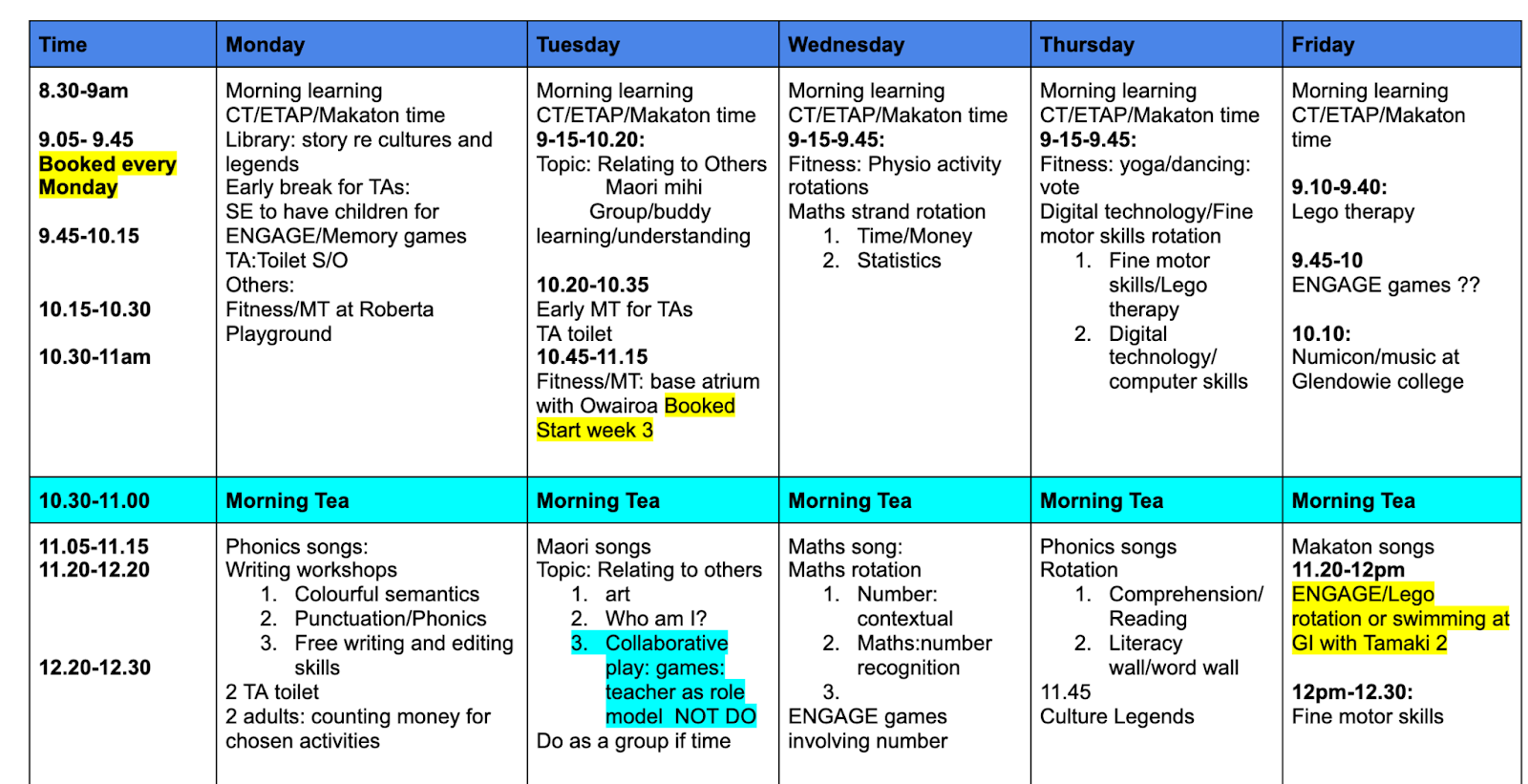
Above is a copy of my timetable from the first term:

I think I expected too much with regards to collaboration with my colleagues.

  1. Music and Numicon worked well with the Glendowie college as we were using the teacher’s strengths. The issue became transporting my class and also additional louting that each class had organised.

  2. Swimming with Tamaki Primary, Adele, was hit and miss. Upon reflection this was a result of teachers trying out new grouping, swimming pool issues, behaviour issues and transport issues. When it worked, it worked really well.

  3. Meeting up with Owiaro for fitness. Susan and myself are very aware of the fact that we can’t provide certain opportunities for our learners at our host schools. BUT they are available at BASE. A big sfe sensory garden, a swing, bikes and a big trampoline. The aim was to meet at Base every Tuesday MT time so that the children can have a “play” and just be with one another as they were meeting each other for the first time. 

Issues arose: transport and my release day was on a Tuesday. We wanted to keep it to a Tuesday when the physios were at Base so could come and see our children. Term 1 did not really work. However we reflected and looked forward to how it could look better for term 2.


Reflection:

. My expectations were too high.

. Transport was always an issue.

. When it worked it looked amazing.

. Everybody needed to be onboard.

. Building in more time than you thought was needed, especially for getting the children to different places.


Questions relating back to hunches:

  • What is the purpose of collaborating with another class during learning time?

  • How effective from a teacher’s point of view is collaborating with others during teaching time?

  • Is it worth it when there may be a few barriers to overcome?


Wednesday, 5 May 2021

Interventions to support student collaboration

 Interventions:


Name of intervention

PEERS

Program for the Education and Enrichment of Relational Skills. 

Type of intervention

Social Communication

Description (what it involves, what happens)

14 week Evidence based social skills, caregiver supported intervention for adolescents or young adults or a 16 week evidence based social skills intervention for adolescents, school based.  PEERS approach targets social skills and looks at core social challenges for individuals on the spectrum with a focus on adolescents and adults. PEERS breaks down social skills into rules and steps of social behaviour. It uses specific lessons, demonstrations,  role play, as well as homework/assignments to practice in other settings to generalise the new skills. Adult leaders follow a guide/manual for week and day activities ands steps. 

History

The first evidence based intervention for teaching and developing social skills. Developed by Dr Elizabeth Laugeson and colleagues at UCLA. 

Dr Elizabeth Laugeson as cited in (University of California, 2015)  "It's as if we've forgotten that these children grow up to be adults with their own unique challenges that very often affect their ability to be gainfully employed or establish meaningful friendships and romantic relationships.” PEERS recognises the need to ongoing support into adulthood to ensure a positive quality of life for the autisic individual and their families. 

Aims/theories

To teach autistic individuals social skills through didactic lessons, role play demonstrations, group socialisation activities and home learning for generalised skills. 

Claims

To be the first and only evidence based practice for social communication skills. 

Summary of the evidence and Ranking

Studies looking at social skills for adolescents with autism are limited and there is a limited number of evidence based interventions to compare PEERS. 

Research around progress has shown there is an increase in social skill awareness from improvement in TASK results however often within autisc individuals there still is a lack of generalising into other social settings. This highlights the importance of maintaining these skills and continuing to work on these after the programme has finished. 

PEERS has a strong theoretical perspective and provides screening, goals, lessons, step by step information, case studies as well as parallel programmes for parents to ensure that social skills opportunities happen within family context. 


According to the NZ Guidelines Group (2016) approaches should emphasize pivotal skills such as spontaneity, initial, motivation and self management. This is ranked C, This aligns with the aims and steps of PEERS. 

References and/or readings

Research Autism (nd). Interventions: Treatments and Therapies for Autism Spectrum Disorder. Retrieved from: http://www.researchautism.net/autism-interventions/types

University of California - Los Angeles. (2015, July 31). Young adults with autism show improved social function following skills program: Gains from 'PEERS' training persist 16 weeks later. ScienceDaily. Retrieved August 25, 2020 from www.sciencedaily.com/releases/2015/07/150731103705.htm

PEERS for Adolescents (2020), UCLA PEERS Clinic., Retrieved from ; https://www.semel.ucla.edu/peers/teens

Laugeson, E. A. (2013). The PEERS curriculum for school based professionals : social skills training for adolescents with autism spectrum disorder. Routledge.

New Zealand Guidelines Group. (2016). New Zealand Autism Spectrum Disorder: Guideline. Wellington, New Zealand: Ministry of Health


Name of intervention

Attention Autism

Type of intervention

Focus on Joint Attention

Description (what it involves, what happens)


Attention autism focusses on joint attention and communication skills through fun learning activities. The programme moves through a series of 4 stages of quality engaging activities. Start at stage 1 and move up when the child's attention is ready to be extended. 

Focuses on spontaneous engagement. 

Provides a framework where we can nurture social skills, communication and thinking skills. 

Start with being visual and memorable. 

Stage 1: Bucket time - visually engaging games and toys to gain shared attention of the bgrup. Adult leader comments on objects with simple and repetitive language. 

Stage 2: Attention builder activities to keep joint attention focus for longer period of time through a ‘visually stimulating activity’. 

Stage 3 : Turn taking and Re-engaging Attention - Teacher models a simple activity and invites some children to have a turn - teaches turn taking, self regulation if for waiting and learning through modelling. 

Stage 4: Shifting-Re-engaging attention - Adult leader demonstrates a simple creative task and gives the child a tool kit to replicate or attempt. Take the task to a shared table and complete the task independently or as an extension to complete in a peer or as a small group with shared materials. Share finished products with the full class for fun and celebration. 

History

Combined concepts around developmental psychology with good autism strategies is where the Attention Autism programme came from. By creator Gina Davies a speech and language therapist. 

Aims/theories

Aims to develop natural and spontaneous communication and gaining attention through visually based and motivating activities. 

Primary objective “sessions are fun and offer an irresistible invitation to learn”! (Centre for autism n.d)

Aims:

  1. To engage attention

  2. To improve joint attention

  3. To develop shared enjoyment in group activities

  4. To increase attention in adult-led activities

  5. To encourage spontaneous interaction in a natural group setting

  6. To increase non-verbal and verbal communication through commenting

  7. To build a wealth and depth of vocabulary

  8. To have fun! (Centre for autism n.d)

Joint attention is a known deficit in children/individuals with autism. There is a broad range of categories that come under attention and these features are reflected in the Attention Autism Program. 


Orienting attention is when you move your physical body towards a person or tangible object. This is reflected in stage 1 when the attention is on the bucket and what is coming out of the bucket. It grabs attention and is motivating. 


Sustaining attention is the ability to maintain  attention to a stimulus. This refers to stage 2 and 3 of Attention Autism where the activities are longer and turn taking can be involved. 


Shifting attention:

Requires the individual to change from one stimulus to another. This is evident in Attention Autism in stage 4 when the child observes and then collects materials and completes an activity changing their attention and focus. 


Social versus non social stimuli are both aspects of Attention Autism as the activities invite the learners into the social world through repetitive language and visual appeal through objects and following the steps of an adult leader as you progress through the stages. 


All of these elements make up Joint Attention. “Joint attention refers to shared attention between two individual and an object or another individual. Joint attention involves all three of the previously mentioned components of attention and is always social in nature.” (Patten, 2011)

Summary of the evidence and Ranking

Overall there is still a lot of evidence that needs to be bought together. Most practice evidence does not involve a control group and needs smaller group sizes for the evaluation to be considered for EB. In all of the online reviews of people using the programme it is hugely positive and shared attention and joint attention along with communication are all areas where there is evident progress. 


The programme also aligns with rankings from the NZ Guidelines Group (2016) recognising that spontaneous communication, socialization and play goals should be a priority -ranked A, the childs or young person's particular interests should be incorporated wherever possible rank C and that interventions should take place in natural settings, using natural routines and natural consequence rank A.

References and/or readings

Research Autism (nd). Interventions: Treatments and Therapies for Autism Spectrum Disorder. Retrieved from: http://www.researchautism.net/autism-interventions/types

Center for Autism (n.d) Attention Autism. Retrieved; https://best-practice.middletownautism.com/approaches-of-intervention/attention-autism/

Patten, E., Watson, L., (2011) Interventions Targeting Attention in Young Children with Autism. American Journal of Speech and Language Pathology, VOL 20 pg 60-69

Marsh, F., (2019) Attention Autism for CHildren and young people on the autisic spectrum: A critique of the current evidence base. Doctoral Programme in Educational Psychology. University of Southampton

New Zealand Guidelines Group. (2016). New Zealand Autism Spectrum Disorder: Guideline. Wellington, New Zealand: Ministry of Health


Name of intervention

SCERTS 

Type of intervention

SCERTS can be classified as a combined intervention as it blends elements of behavioral and developmental models

Description (what it involves, what happens)

SCERTS is child centred and builds on developmental rather than behavioural theories. 

“The SCERTS® Model is a comprehensive, multidisciplinary approach to enhancing the communication and socioemotional abilities of young children with autism spectrum disorder. SCERTS® refers to Social Communication, Emotional Regulation, and Transactional Support, which are priority goals in supporting the development of children with ASD and their families” (Prizant & Fields-Meyer, 2015)

Aims/theories

Develop spontaneous functional communication, adapt to an environment and partake in relationships with adults and peers. 

Summary of the evidence and Ranking

SCERTS is evidence based and supports family-professional partnership in working towards improving quality of life for the individual and their families (Molteni. P et al. 2013). The targeted areas in the model are around joint attention, initiating communication, symbol use, imitation, emotional regulation and partner support (Rubin. E. 2017)

References and/or readings

Molteni. P, Guldberg. K and Logan.N (2013) Autism and multidisciplinary teamwork through

the SCERTS Model. British Journal of Special Education. NASEN DOI: 10.1111/1467-8578.12030

Prizant, B. M., & Fields-Meyer, T. (2015). Uniquely human: A different way of seeing autism.

Prizant, B. M., Wetherby, A.M., Rubin, E., Laurent, A.C., & Rydell, P. (2006). The SCERTS Model: A Comprehensive Educational Approach for Children with Autism Spectrum Disorders. Baltimore, MD: Paul H. Brookes Publishing.


Name of intervention

LEGO therapy

Type of intervention

Social development

Description (what it involves, what happens)

LEGO therapy is a social development program for autistic children and other children with social communication difficulties. It uses children’s love of LEGO play, as well as their strengths and interests, to develop communication and social skills.


LEGO therapy is used to teach children skills like turn-taking, sharing, listening, conversation, teamwork, shared attention and problem-solving.

History

LEGO®-Based Therapy was developed in the mid-1990s by US pediatric neuropsychologist Daniel LeGoff. He use to work 1:1 but after a spontaneous interaction between clients in his waiting room focused on a shared interest in a LEGO kit he decided to start doing his sessions in small groups and thus LEGO therapy was started. 

Aims/theories

The main aim is to encourage children to collaborate with each other. 

References and/or readings

Raising Children (2021) LEGO therapy. Retrieved from: https://raisingchildren.net.au/autism/therapies-guide/lego-therapy 


Bricks for Autism (n.d) Retrieved from: https://bricks-for-autism.co.uk/about-lego-therapy/ 


Pre Assessment - Collaboration in 2021


This year my focus is on student collaboration within the classroom. How can the students collaborate during learning and how can we collaborate with the learners. I wanted to get an idea of key areas of strengths and key areas of challenge for my learners. I completed a Behaviour Assessment System for Children (BASC). This is a teacher rating scale to monitor changes and progress in children’s behaviour or emotional status (“BASC”, 2015). 


Within my class these were areas I recognised as areas of challenge:


  1. Attention

  2. Distraction

  3. Listening skills to others

  4. Speaking out of turn

  5. Trouble with stop and thinking before acting

  6. Has better relationships with adults rather than peers.

  7. Nervous/ loses confidence easily  


Areas of strength picked up in the BASC

  1. Everyone is well intentioned

  2. Does not want to upset others

  3. Listens to adults

  4. Follows direction when spoken to directly by an adult


I found this particular assessment was a great starting point and allowed me to get general information however I did find that it did not go into enough details particularly with how learners interact with each other to achieve something. Going forward I am going to look at how a range of interventions and activities can be used to support student collaboration and also use these assessment tools which will hopefully add more information and create a more detailed goal for the individuals. Going forward the interventions and activities we will implement and monitor will be:

  • SCERTS

  • ENGAGE

  • LEGO therapy

  • PEERS programme

  • Attention Autism - stage 3 and 4

These interventions will be implemented within class time, with some being for all learners and some for targeted individuals. 


Reference:


BASC-3: Solve behavior issues today. For better lives tomorrow. (2015). Pearson Education 510F241 10/15

Wednesday, 24 February 2021

Welcome to 2021!

 Welcome to 2021!


Tash and myself are lucky to be COL teachers for another year! We get to learn, create and share with an amazing group of adults, both in the Manaiakalani cluster and within our Sommerville school. Last year Tash and myself were based in a double satellite at Stonefields school. This aided our initial year into research about collaboration. However this year, Tash is at Glendowie College satellite, (a new satellite opened this year) and I am now based at Glendowie Primary school satellite. Our overarching theme is still collaboration, BUT we are now going to take a different approach on it. Sharon: is going to be focusing on how adults collaborate and how this may look and influence student learning Tash: is focusing on student collaboration and how to ensure this can occur within a variety of activities and environments. We are still “collaborating” as we are both working toward the same end goal of how collaboration may look in our school! Watch this space!