Tuesday, 9 June 2020

Reflections on reading......

Reflections and thoughts after reading:


Creating collaborative effectiveness One school’s approach:
by Sarah Martin and Chris Bradbeer

I have picked out some phrases from the reading which I found significant, powerful and really relevant to our inquiry:

  • collaboration can be an opportunity, but also be challenging at times


This is so true. Collaboration brings together a difference of opinions, true collaboration may mean you need to see the bigger picture and you may be heard, but it might not be the answer.

  •  growing teacher capacity to have sensemaking conversations, a disposition seen as especially relevant when teachers are working together


These have also been known as hard to have conversations. But should they truly be hard to have?? Sensemaking needs different thoughts and ideas, being able to explain and express your own thoughts is a good thing, even if others may not agree, they may still want to understand.

  •  Keeping in mind that a prime reason for creating a culture of collaborative relationships and responsibility is, as DuFour and Mattos (2013) note, to impact positively on student outcomes,


The aim for this inquiry is to enhance your collaborative skills in order to improve the experiences the children have at school and that they benefit from the experiences we are able to give them through effective collaboration. The child is always the centre.

  • working so closely with colleagues comes with its benefits and challenges.


When you use people’s strengths, the learning can be amazing,
teacher’s can learn and grow and share. The challenges provide
exacting the same opportunities.

  •  It became obvious that these teams (operating highly effectively) had mechanisms and systems in place to surface and talk about the non-discussables.


What can you put in place to make it easy for all to be on the same page and make collaboration work.This can be school wide and the different Pathway unique. Always be open minded.

  • How much time do you spend meeting as a team? • How do you work to your team strengths? • How do you organise what you do together?


All questions that we need to ask ourselves and our teams. Time has been identified as a barrier, so we need to focus on this to enhance and improve our use of time.
  • —the management of conflict in the team.   Gaye Greenwood - Sensemaking


Conflict or sensemaking isn’t necessarily a bad thing, that people worry about. Could it become the norm??? All communities have conflict to be able to grow, develop and move forward. Recognising the importance of conflict can allow us to see it in a different light and appreciate the positives that can come from sensemaking conversations.

  • Table of Collaborative Teacher dispositions


Ask yourself where do you think you are on the table. Then build your knowledge and reflect.

  • Collaborative Framework: Growth Mindset, Learner, Self aware


We all need to look within before we look out and develop our ability to collaborate.

  • As Hansen (2009) notes, disciplined collaboration is the “practice of properly assessing when to collaborate (and when not to) and instilling in people both the willingness and the ability to collaborate when required” (p. 15).


Collaboration may not look the same in every area of the school. There are in fact different ways to collaborate, so when and how are questions to be asked, to best suit the situation at the time and the children.

  • There has to be a reason to collaborate.


You don’t just do it just because you are told to.

  • We have watched the most synergetic teams provide time and forums to have conversations about how individuals like to be supported, how they like to be communicated with


This is important. Collaboration within teams, bring different personalities. You need to be open and honest, otherwise how are you going to be heard. The confidence in the team needs to be there so you are happy to speak openly.

  •  John Hattie at the recent 2016 global chat said that “The essence of teachers’ professionalism is the ability to collaborate with others to maximise impact”.


With the child being in the centre and gaining positive learning and experiences, it is key for teachers to continue to learn and grow and gain more tools/resources in their kete.

Thursday, 14 May 2020

Article reviews on Conflict/Relationships in Collaborative work place

When starting to research how ethical dilemmas are managed in the school environment both my school and host school turned to “Our Code, Our Standards- Code of Professional Responsibility and Standards for the Teaching Profession”. The code of conduct covers what was previously called ethical issues. The Code of Professional Responsibility now guides  this process, setting us with behaviour expectations, high standards and creates trust in the teaching profession. (Our Code, Our Standards, 2018)

In my new COL position and relevant to university studies a code that needs particular consideration for my current learning is “1.2 Engaging in professional, respectful and collaborative relationships with colleagues” (Our Code, Our Standards, 2018).

As we learn how to navigate and support collaborative work places it becomes clear that there is also a need to understand the role of conflict in the modern learning environment. Conflict can be understood as “ a situation or an ongoing process in which views and behaviours diverge (or apparently diverge) or are perceived to be to some degree incompatible” (Achinstein, 2002). Groups clash and opposing ideas are exposed.

Collaboration can create opportunities as professionals are brought together however it is important to acknowledge the challenges and conflict that can appear with teacher - teacher relationships. Teachers individually and collectively hold values that shape their practice. Finding ways to respect and trust colleagues helps create and maintain relationships within schools and between teachers. Bradbeer, Martin (2016) say this is a critical element of positive school-wide change “successful collaboration is the most significant contributor to school organisational culture”.

Bradbeer, Martin (2016) have created an inquiry which looks at collaborative effectiveness. A key element in the article focuses on the need to build teacher capacity to manage conflict when issues arise. They found through inquiry that less effective teams did not have the same capacity to address “non discussibles” (Barth, 2002, cited in Bradbeer Martin, 2016). Barth (2002) describes non discussables as “subjects sufficiently important that they are talked about frequently but are so laden with anxiety and fearfulness that these conversations take place only in the parking lot, the rest rooms, the playground, the car pool, or the dinner table at home. Fear abounds that open discussion of these incendiary issues—at a faculty meeting, for example—will cause a meltdown” (p. 8). This results in potential conflict or issues being avoided which results in frustration.

For successful collaboration there needs to be a team understanding of the value of growth mindset, prioritising issues and working in synergy. A key contributor to this is being able to address unresolved issues. Gaye Greenwood looks at the term sensemaking to break down the dilemas. Sensemaking allows the individuals to address the hard to talk about issues through discussion and making meaning through collective experiences. Sensemaking is theorized as a response to ambiguity, uncertainty and change ( Weick, 2001, 2009). It is a speaking, listening and thinking process. Third party sensemaking partners may be involved in the discussion to offer clarification, comfort and offer validation from a point of view of not being directly involved (Greenwood. 2016). Weick defined sensemaking with 7 key properties. “Social context, identity construction, retrospection, cue extraction, ongoing, plausibility and enactive of the environment” (Archinstein, 2002).

These properties as part of sensemaking suggest that conflict is social and that decision making is anchored in identity as people search for meaning (Greenwood, 2016). We need to show up and use retrospective experiences to give direction and meaning to future endeavours. “When people act on what is plausible they might forget alternative possibilities which can have large consequences” (Greenwood, 2016).

By engaging in difficult conversations colleagues are beginning to participate in conflict management. “the process of limiting the negative aspects of conflict while increasing the positive aspects of conflict. The aim of conflict management is to enhance learning and group outcomes, including effectiveness or performance in the organizational setting” (Greenwood, 2016).
In the case of schools, conflict management is a complex, dynamic phenomenon. Schools are in essence communities within themselves. If we want communities of practice to have longevity then we need to better understand the role of conflict in communities. Conflict in communities can be positive for instigating the need for change and subsequent growth. Archeinstein (2002) says “Active engagement in conflict, a dialogue of differences, is a normal and essential dimension of a functioning teacher community. Conflict can create the context for learning and thus ongoing renewal of communities”

Conflict dialogue can be emotive. We can make sense of these dilemmas by reflecting. “Critical reflection is as essential as collaboration to strong communities” (Archinstein, 2002). Learning how to acknowledge diversity of beliefs and practice having opposing ideas in a public space, allowed for critical reflection and acceptance of a variety of issues. After looking into two different schools in a study around conflict in workplaces Achinstein (2002) found that “ when conflict is brought to the surface, when it becomes real, then transformation could occur”. Reflection and conflict offer a community the opportunity for change.

Bradbeer, Martin (2016) found in their inquiry that the “capacity to give and receive trust, to sensemake and be open, bridges a threshold that helps to move from an “I” space to a “we” space, a critical component of working together”.

For teachers to be successful at collaboration they need to open doors to their classroom and share their values and beliefs to their community. Policy makers and senior leaders need to understand and respect the complexity at hand and give time and training to support teachers to grow and learn in this new environment. If we can spend time developing the teacher's ability to grow and be ok with being uncomfortable, then the collective outcomes from recognising individual strengths to benefit a group will have positive impacts on our learners. Bradbeer, Martin (2016) have found through time and inquiry that there is a correlation between synergetic teams and accelerated outcomes for learners.

Reference List:
Achinstein, B (2002). Conflict Amid Community: The Micropolitics of Teacher Collaboration. Teacher College Record Volume 104 Number 3.
Bradbeer. C, Martin S, (2016), Creating Collaborative Effectiveness One Schools Approach. Teachers as Communities of Learning Professionals, Set 2. 
Education Council New Zealand–Matatū Aotearoa. (2017). Our code our standards: Code of professional responsibility and standards for the teaching profession: Ngā tikanga matatika ngā paerewa: Ngā tikanga matatika mō te haepapa ngaiotanga me ngā paerewa mō te umanga whakaakoranga. 
Greenwood. G, (2016) Transforming Employment Relationships? Making sense of conflict management in the workplace. [ Doctoral Dissertation]. Auckland University of Technology.

Wednesday, 6 May 2020

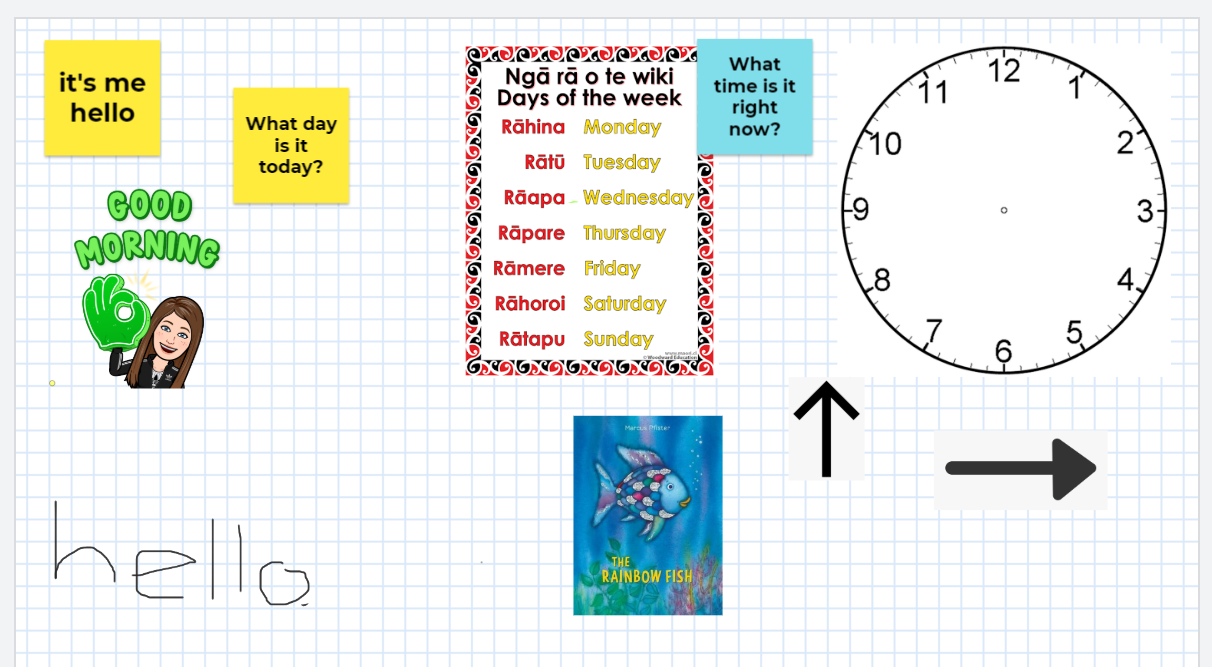
Tools to use when collaborating

Tash and myself have been researching the different types of tools/app that we can incorporate and use when gathering information and ideas from our colleagues within Sommerville and further afield if we choose to go down this path.

Being in the situation that we are, working from home has given us the opportunity to investigate and learn about different technology that can help us to collaborate with one another.

Both these tools are interactive, it is not a “ look and listen” time it is more a “lets get involved” and share our thoughts and ideas.

This provides triggers for further discussions.

It is a live doc as well so can be added to and shared, providing evidence of people’s voice.

We have initially shared these 2 tools with our Sommerville COL colleagues for a further discussion on them.

Jamboard:


Pros:
Provided by Google, which we all use.
Can see each other's things as they are created.
Few options on how to present your ideas
All work on it together
Could we also use this with our children in class as they all have google accounts?
Shared information/working document that can be saved and referred to.
You can personlise it.


Cons:
No voice recording options
Extra app/tool to have, not used in Google

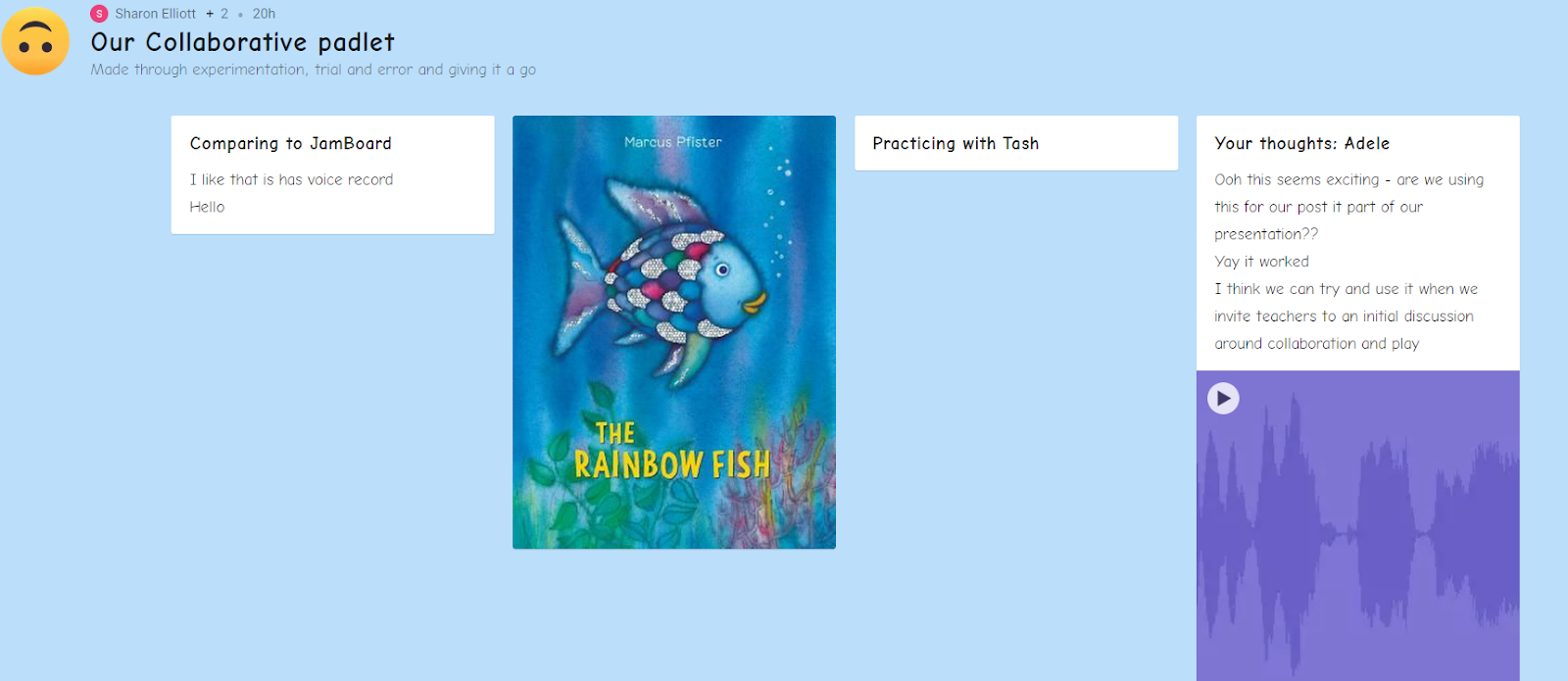
Padlet:


Pros:
Shared information/working document that can be saved and referred toHas voice recording
You can personalise it
The notes are organised automatically 
You are able to also share images and photos

Cons:
Editing options limited, the creator has more than the people shared into it
3 free Padlets, if you want more then you need to pay monthly subscription
Time delay before seeing what others have written

As yet we have not decided which one we would like to use, so sharing it with our COL colleagues at Sommerville is a good way of getting more feedback about them.


Learning to Collaborate online

To increase our knowledge and awareness of our new COL role all of the Sommerville COL staff have been meeting online each week. This is a great chance for us to learn with, from and about each other, brainstorming ideas. We have created our own community of practice within the COL. This is a great opportunity for us to give each other feedback on our learning goals and blogs and a chance to feed forward.

These group catch ups are invaluable and having the time while at home to make these regular has been a positive of working from home. We are already looking at how we will continue these sessions when we reduce down to level 1.

This allows us to share resources, learning links and presentations. We have created a Google Drive folder where we can keep track of notes and also share new information so everyone has access.

Through Tash’s university study she has created a Collaboration presentation which was shared with his group of teachers which has links to reading references and will be used to share information back with our school colleagues.

Through these group discussions we created with Devs the collaboration survey which generated our baseline data of our colleagues' understanding and connection with collaboration in their current practice.

Having Devs in this learning group is excellent, as she comes with knowledge from being in this role last year. Having a more knowledgeable learning partner is very important when co operating and growing as teachers. We all have a passion for play based learning and collaboration and all bring with us different strengths. This environment creates endless opportunities for inter professional learning.

Thursday, 30 April 2020

HYPOTHESES and Possible Next Steps:

Our Teaching as Inquiry Hypotheses

  • If we want a positive impact on learning in our hub then what does effective collaborative teaching look like?

  • What does effective collaboration look like?
  • If  we all view collaboration and interpret it differently then  how do we use it in school?
  • If we are to be a synergetic team then how do we all get on the same page about collaboration?
  • If we collaborate effectively with the child's whanau what benefits does this have on their learning?
  • If we are to find best practice of collaboration then where is the best place to find it?
  • What forms of collaboration are most important?


Next steps:
We are at the start of our COL collaboration journey at Sommerville. There needs to be a lot of opportunity for observation between staff and opportunity for feedback to feed-forward learning and teaching practice. With this data we have been able to get a better insight into how the staff at Sommerville work with and feel about collaboration. As there are many different pathways (sensory, satellite, base, senior, junior, positive engagement) in the school, all with different needs we want to gain a clearer picture on how collaboration would work and look in different parts of the school. Our next step is to spend time discussing this with teachers from a range of pathways. 

We don't necessarily have the answers: just pose questions and give food for thought, experiment and share back our learning.

Digging Deep into Initial Data Part 3

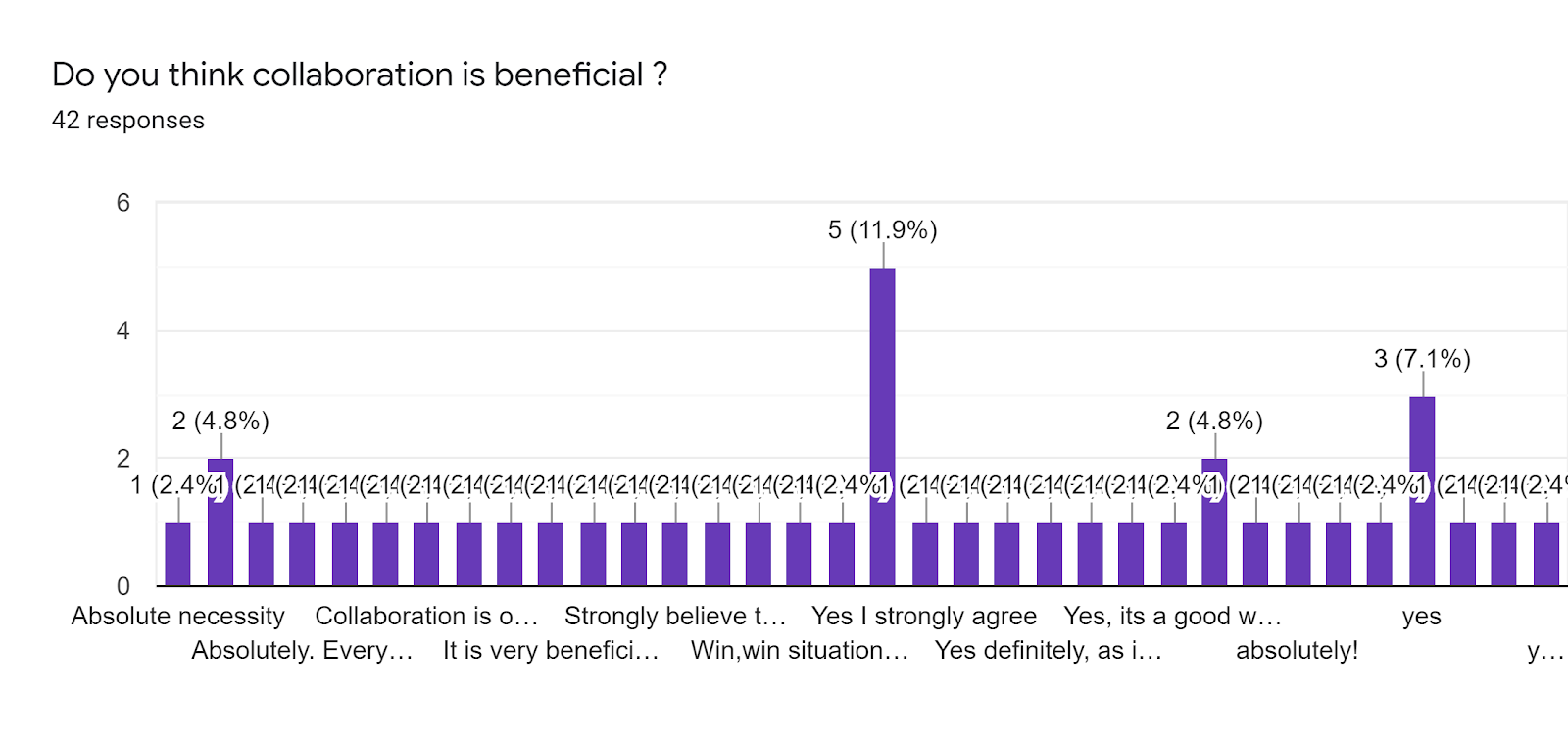
Forms response chart. Question title: Do you think collaboration is beneficial ?. Number of responses: 42 responses.
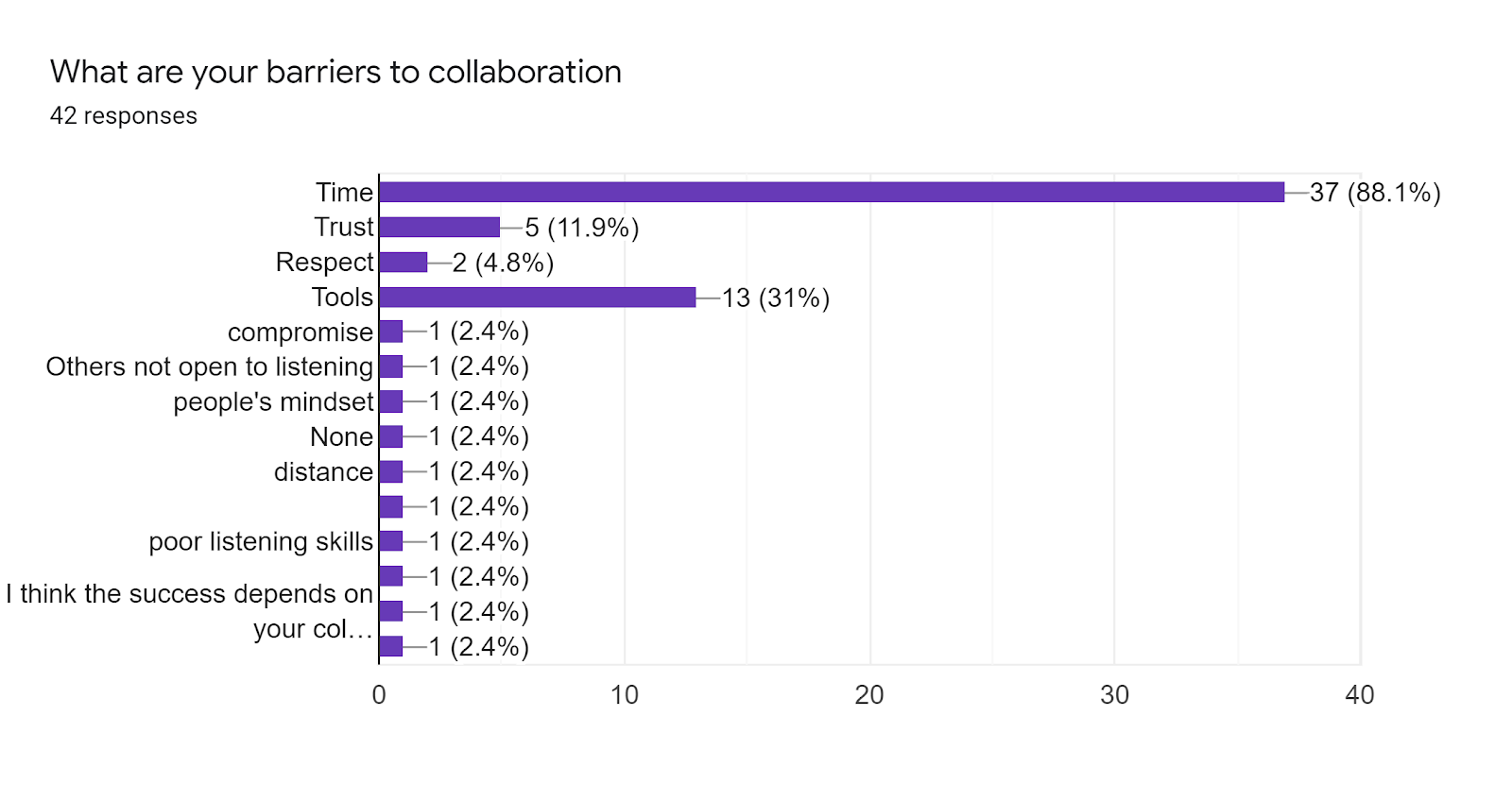
From the data everyone agrees 100% that collaboration is beneficial but does this information represent practice and is this actually true? Collaboration has to fit the situation and has to be purposeful. One of the responses states that for it to be beneficial people need to understand it so that it is used effectively. This is something Sharon and Tash  believe is very important and is a message we will be elaborating on through this blog. We need to better understand the meaning of collaboration so that we can see when and how to use this in the classroom. Life and learning can happen without collaboration but two heads are better than one when used effectively. Forms response chart. Question title: What are your barriers to collaboration. Number of responses: 42 responses.
The main barrier portrayed in the data is time. This is a word all teachers can empathise with. We need to use our blog opportunity to investigate how this can be overcome. How can we use time to support collaboration i.e sharing work to reduce workload. Tools was also a common factor, we need to research appropriate tools that people can choose to interact with that best suits their environment. Trust was the third factor of concern which is very vital in collaboration. We need to spend time looking at how we can develop trust, build trust and work alongside different people. In order for collaboration to be effective you need a level of professional trust, how can we develop this?

Digging Deep into Initial Data Part 2

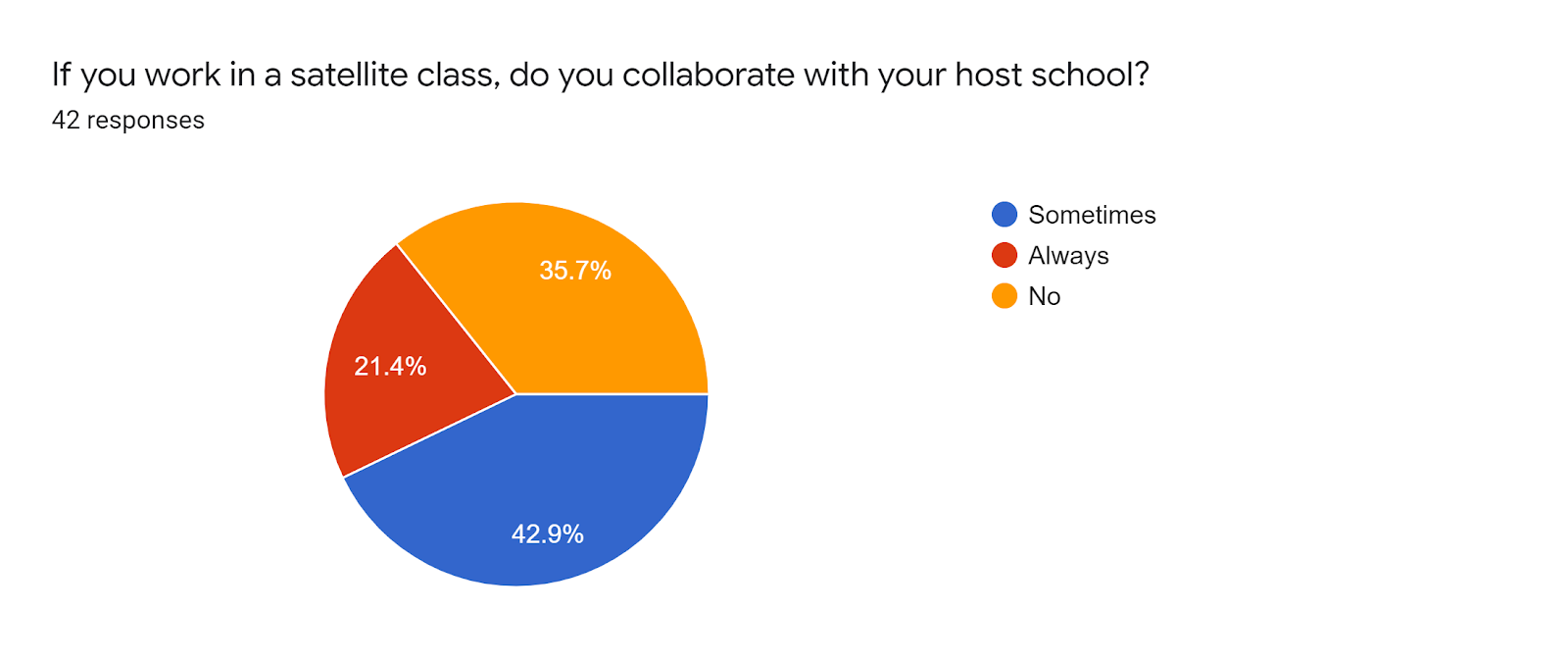
Forms response chart. Question title: If you work in a satellite class, do you collaborate with your host school?. Number of responses: 42 responses.

  • Over a third of the satellite classes feel as though they do not collaborate with the host school.
  • Is the purpose of a satellite class not to just be a stand alone but to try and find ways of integrating some of the children’s learning alongside the mainstream. Using them as role models and vice versa.
  • It is an excellent resource right on their doorstep.
  • What are the barriers here???
In reflection: Satellite classes create an opportunity for better understanding among the community to then build stronger relationships. This is not just for students but benefits everyone in the school community. Are satellites offering opportunity for PD to host school?


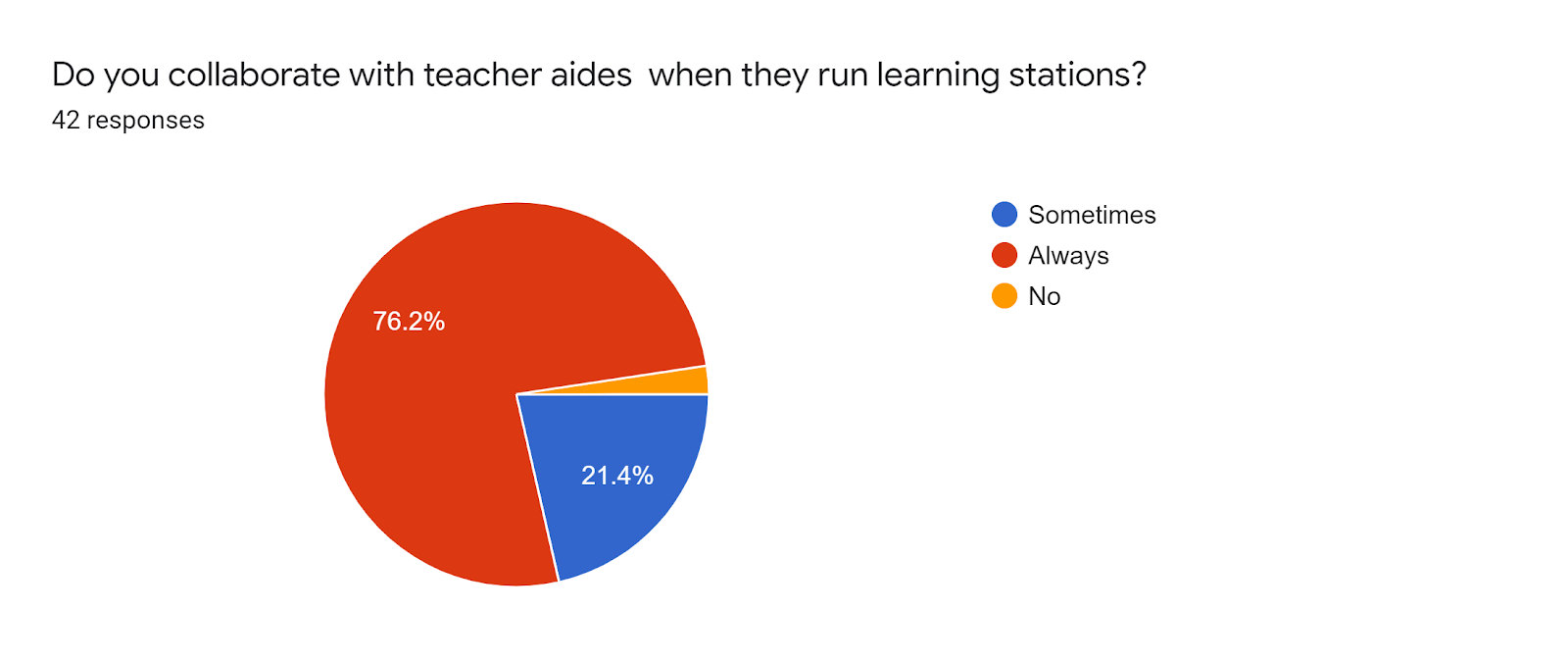
Forms response chart. Question title: Do you collaborate with teacher aides  when they run learning stations?. Number of responses: 42 responses.

This is a very important aspect of a special school: the relationship between teacher and teacher aides. We are wanting to better understand how teacher aids are involved and playing to their strengths. According to the data currently over 75% of staff feel they are working alongside their teacher aides. Due to our high teacher aid ratio this is very important. In reflection: This graph was also depicted from information only from the teacher point of view, we are also wanting to ask teacher aids the same question. For collaboration to work well in the classroom there needs to be opportunities for group learning and break out space that in a special school is supported by teacher aid resources. Do teacher aides feel they understand the learning and activities? How can we best support this relationship to ensure successful and meaningful collaboration is in place?